
Transparency is my favourite thing to build into an association. Here's how.
One of the most valuable improvements an association can make is creating greater transparency across its operations. When financial information is difficult to access, documents are scattered and responsibilities are unclear, even the most dedicated boards and teams can struggle to work effectively. In this article, we explore five practical ways to build transparency into your association, from giving board members better financial visibility and introducing shared project management systems to centralising documents, securing organisational accounts and clarifying governance responsibilities. Transparency isn't about micromanagement. It's about giving everyone the information, tools and confidence they need to fulfil their responsibilities. Discover how a few simple changes can strengthen governance, reduce administrative pressure and create a more sustainable association. At Association Management Experts, we help associations put these foundations in place so they can spend less time chasing information and more time supporting their members.
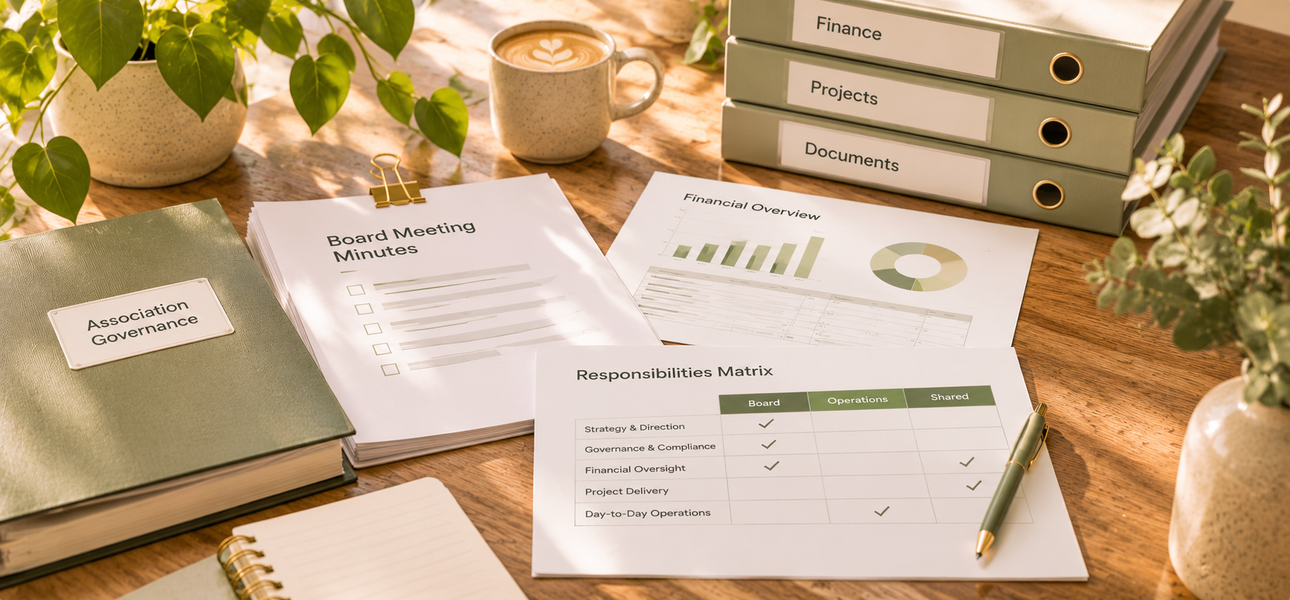


Financial visibility, clear responsibilities, organised information and systems that don't depend on one person knowing everything.
One of my absolute favourite things to do when we take over the management of an association is create transparency.
It sounds simple, but you'd be surprised how often it's missing.
Associations have a unique operating environment. Staff might work remotely, board members are often volunteers, and the people responsible for running the organisation may rarely be in the same room.
And even when everyone works together, that doesn't necessarily mean everyone knows what's happening across the association.
Information gets siloed. Tasks live in people's heads. Documents disappear into personal folders. And sometimes the only person who knows how something works is the person who's just resigned.
My obsession is making sure that doesn't happen.
Because transparency isn't about micromanaging people. It's about giving everyone the visibility, information and tools they need to do their jobs properly.
Here are five things I put in place.
1. Financial transparency: every board member needs visibility
The first thing I want to establish is financial transparency.
Yes, the treasurer typically oversees the finances and presents financial reports to the board. But that doesn't mean the rest of the board can simply leave financial oversight to one person.
Board and committee members share governance responsibilities, including oversight of the association's financial position and solvency.
That's an important distinction.
You don't have to be the treasurer to be responsible for understanding the finances.
Where practical, I like board members to have individual, read-only access to the accounting software, with appropriate security controls. At a minimum, they should have timely access to reliable financial reports, budgets and cash-flow information.
They should also feel comfortable asking questions about the numbers at any time.
No waiting until the next AGM. No relying entirely on one person to interpret the financial position.
If you're interested in what I look for when reviewing an association's finances, I've covered that in my recent article, The First 4 Things I Look at in an Association's Finances (And What They Tell Me).
2. Project management: get everything out of people's heads
This is probably the one I'm most passionate about.
I firmly believe every association needs some form of shared project management system.
And before anyone says, "We don't have the budget," hear me out.
Years ago, I was working full-time, spending around 15 hours a week commuting, studying for my degree part-time and attempting to maintain some kind of social life.
My life was absolute chaos.
I needed one place where I could see everything I had to do, when it was due and what needed prioritising.
That's when I discovered project management software.
It was free. And it completely changed how I organised my life.
I've been obsessed ever since.
Fast-forward to today, and there are so many affordable tools available that budget really shouldn't be the barrier. Even a well-organised spreadsheet is better than having everything scattered across emails and people's memories.
At AME, we use monday.com, which offers eligible nonprofits discounted pricing. More information here is you if you are interested to learn more.
Here's how we keep it simple.
We create a reusable checklist for almost every recurring activity in an association:
- AGMs and board meetings
- Webinars and educational events
- In-person events and annual conferences
- Membership renewals and communications
Every time a new activity comes around, we duplicate the relevant checklist and adapt it.
Does every event run exactly the same way? Of course not.
But if 80–90% of the process is already documented, you're starting from a much stronger position.
And we have two non-negotiables:
Every task has one accountable owner and a due date.
That's it.
Now we can see what's happening across the association, what's overdue, what's coming up and who's responsible.
It also completely changes workload conversations.
When someone says they're overwhelmed, we don't have to guess what's on their plate. We can look at the work together, agree on priorities and shift deadlines or responsibilities where necessary.
No blame. No guesswork. Just visibility and better decisions.
3. One central home for every document
This sounds obvious. But the reality can be quite different.
Documents are scattered across personal Google Drives, old Dropbox accounts, someone's desktop, email attachments and folders nobody remembers creating.
And then a board member completes their term or an employee leaves.
Suddenly, everyone is asking, "Does anyone know where that file is?"
My rule is simple.
Association information belongs to the association.
Choose a central document management system — whether that's Google Workspace, Microsoft 365 or another suitable platform — and use it consistently.
All relevant organisational files should live there, with access granted according to people's roles.
When someone joins, they receive the access they need. When they leave, that access is removed promptly.
No critical organisational documents sitting exclusively in personal accounts.
It's not just about convenience. It's about continuity, security and protecting the association's institutional knowledge.
4. Passwords and subscriptions: the association must own its systems
This is another big one.
Every association should have its own official email domain and organisation-controlled accounts for its important systems.
Not a CRM registered under a former committee member's Gmail address.
Not an event platform that only one volunteer can log into.
And definitely not a shared spreadsheet full of passwords.
Software subscriptions should be owned and controlled by the association, with clearly designated administrators and a secure process for transferring access.
We recommend using an appropriate password manager, individual user accounts and multifactor authentication, with access permissions guided by the association's IT and security requirements.
Board members should have assurance that the association controls its accounts and can recover access when needed — not that everyone needs to know every password.
Because when someone leaves, the association shouldn't lose access to its own systems.
5. Board responsibilities: make governance information easy to find
Finally, I want every board member to know exactly what they're responsible for and where to find the information they need.
We typically create a central governance hub for our association clients.
This might include:
- The constitution, policies and relevant legislation
- Board member responsibilities and induction materials
- Public liability, professional indemnity and other insurance documents
- Key contracts, delegations and financial authorities
- Meeting minutes, resolutions and important governance records
- Links to the association's regulator and compliance guidance
We also recommend a formal induction and acknowledgement process so board members confirm they've received, read and understood their key responsibilities.
Because joining a board isn't simply about attending meetings and offering opinions.
It comes with real responsibilities.
And those responsibilities should never be hidden away in a folder nobody can find.
Transparency isn't about more administration. It's about less chaos.
When information is visible, responsibilities are clear and systems are properly owned, something wonderful happens.
People stop chasing information.
Boards can make decisions with confidence.
Staff and volunteers can manage their workloads.
And the association becomes less dependent on any one individual to keep things running.
That's the kind of operational foundation that makes an association stronger, more sustainable and ultimately better equipped to serve its members.
At Association Management Experts (AME), this is exactly the kind of work we love — transforming fragmented processes into clear, connected and sustainable operations.
If your association relies a little too heavily on people remembering things, knowing where things are or simply keeping everything in their heads, perhaps it's time for a fresh approach.
Let's talk about creating more transparency in your association.
Official governance and compliance resources by state and territory
For incorporated associations, the applicable legislation and regulator generally depend on where the association is incorporated. Associations registered as charities may also have ACNC obligations, and companies limited by guarantee operate under a different legal framework.
Useful Governance Resources for Australian Associations
Official governance and compliance resources by state and territory:
Queensland — Office of Fair Trading https://www.qld.gov.au/community/fair-trading/associations-charities-and-non-for-profits/incorporated-associations
New South Wales — NSW Government https://www.nsw.gov.au/business-and-economy/incorporated-associations
Victoria — Consumer Affairs Victoria https://www.consumer.vic.gov.au/clubs-and-fundraising/incorporated-associations
Western Australia — Consumer Protection https://www.consumerprotection.wa.gov.au/inc-guide-incorporated-associations-western-australia/not-profit
South Australia — Consumer and Business Services https://www.sa.gov.au/topics/family-and-community/community-organisations/associations
Tasmania — Consumer Affairs Tasmania https://www.consumeraffairs.tas.gov.au/topics/clubs-fundraising/incorporated-associations
Australian Capital Territory — Access Canberra https://www.accesscanberra.act.gov.au/business-and-work/associations-co-ops-and-charities
Northern Territory — NT Government https://nt.gov.au/industry/licences/incorporated-associations
Additional national resources:
Australian Charities and Not-for-profits Commission (ACNC) — For registered charities https://www.acnc.gov.au/
Australian Securities and Investments Commission (ASIC) — For companies limited by guarantee https://www.asic.gov.au/
Project Management Resources
monday.com offers eligible not-for-profit organisations 10 free Pro seats and a 70% discount on additional seats. You can explore the program here: https://monday.com/w/nonprofits